
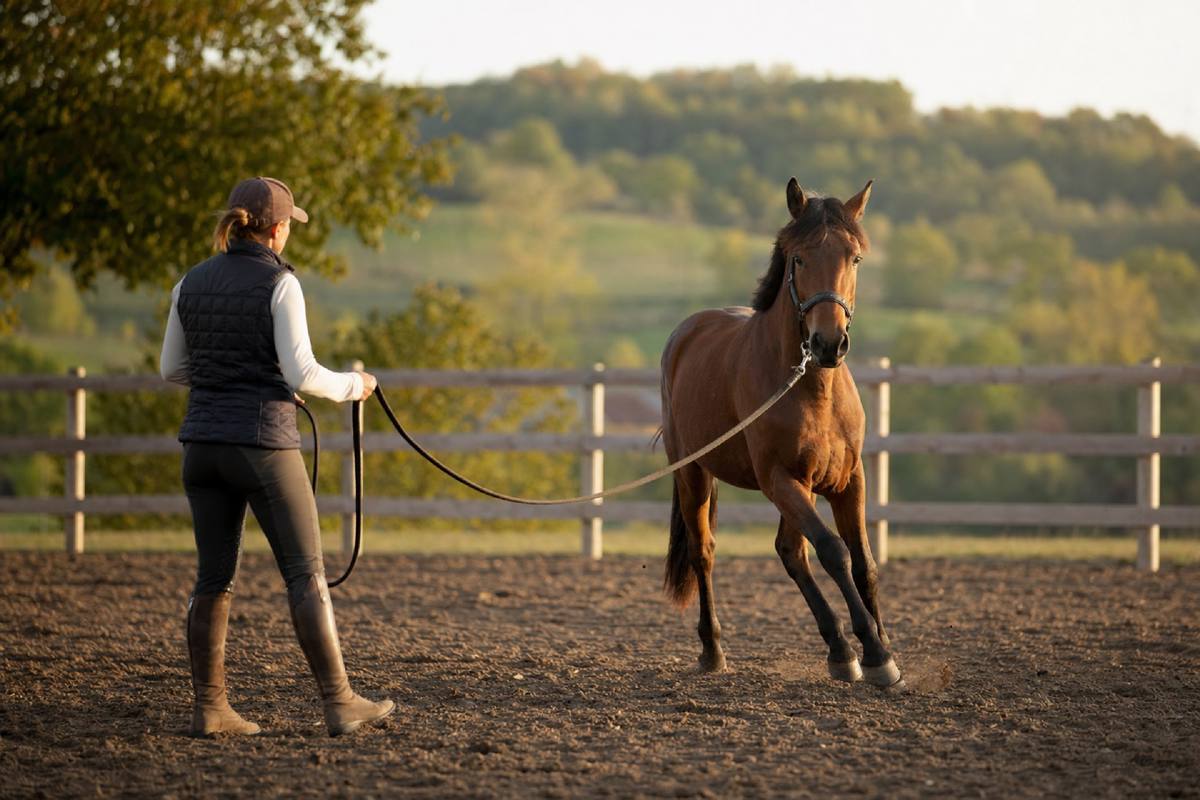
If you want the full walkthrough, watch the episode here: https://www.youtube.com/watch?v=BdMoAwn3FH0. I also deep link to the key transition work here: https://www.youtube.com/watch?v=BdMoAwn3FH0&t=677s and the foundation section here: https://www.youtube.com/watch?v=BdMoAwn3FH0&t=238s.
When I start young horses, I do not use lunging to simply make them tired. I use it to teach them how to think. That is the big difference. A horse that runs in circles and burns energy without a plan is not really learning anything useful. A horse that learns to stay soft, wait for me, and respond to changes in gait is building the kind of mind I need before I ever swing a leg over.


What you need first
This lesson is about colt-starting groundwork, so there are no formal prerequisites for the lunging work itself. That said, the ideas here connect directly to first-ride preparation and forward motion under saddle. If you are already riding, you will get the most out of this lesson by being able to walk, trot, and lope with forward intent and then carry that same clarity back to the lunge line.
For the under-saddle transition ideas in this episode, I treat them as a preview and preparation tool, not as a replacement for actual riding time.
Lunging is about attention, not exhaustion
The first thing I want from a horse on the lunge line is attention. I want him looking to me for direction instead of inventing his own plan. A lot of horses learn the wrong habit early: they equate the lunge line with getting to race around. I do not want that. I want a horse that stays mentally with me, stays soft in his body, and learns that every change I ask for matters.
That is why I pay close attention to what the horse shows me in the circle. If he braces in his neck, holds his breath, falls onto the line, or gets rough in his transitions, I learn a lot about his balance and attitude. Those little clues tell me where I need to improve the horse before I ever ask more of him under saddle.
Why I use transitions so much
My biggest tool on the lunge line is transition work. I like a lot of up-and-down changes: walk to trot, trot to lope, lope back to trot, and back down again. The goal is not to wear the horse out. The goal is to make him wait for me and stay connected to what I am asking.
When a horse runs continuously, he usually gets more keyed up, not less. Once that energy climbs, it is harder to bring him back down and harder to keep his mind with you. By contrast, when I keep changing gears, I can get to the horse’s brain instead of just his legs.
I want fresh legs. I want a fresh body. I do not want a fresh mind.
That might sound backward at first, but it is a very important idea. A horse that is physically exhausted often gets sloppy with his feet, his posture, and his rhythm. I would rather have a horse that is bright and sound in his body but mentally listening to me.
Building self-carriage on the circle
One of the most important signs I look for is whether the horse can hold himself up without dragging me around. I do not want him leaning on the line, cutting in, or pulling through the circle. I want him to stay out there and carry himself.
That is part of what makes lunging valuable for a young horse. If he can learn to travel in balance on the ground, he is far less likely to fall apart when I start riding him. If he is already leaning, rushing, or jumping through transitions on the ground, those problems usually become bigger once I am on his back.
A lot of the safety in my colt-starting program comes from this stage. If I do the groundwork well, I reduce the chance of getting into trouble later.
Teaching the horse to respect each gear
Another thing I am very particular about is whether the horse understands each cue as a specific request. If I say walk, I want walk. If I cluck for trot, I want trot. If I ask for lope, I want lope. I do not want the horse guessing or changing gears on his own.
That matters because the horse needs to learn that each cue has a job. If my cluck means “go bigger at the trot,” then I need the horse to stay in trot and only change the size or energy of the trot. If he breaks into a lope when I wanted trot, then I have not finished teaching the response.
This is a big deal for show horses later on, but it starts right here on the lunge line. I am building the horse’s understanding of the button before I ever need to use it under saddle.
Using the lunge line to prepare for the first rides
For young horses, I want to remove as many surprises as possible. If a horse makes his own transitions, gets anxious, or becomes unpredictable on the line, he is much more likely to scare himself when I first ride him. That is why I am so strict about the quality of the work here.
When I control the transition, I can control the horse’s confidence. That gives me a safer first ride and a better foundation for the weeks that follow. If a horse jumps through the down transition or rushes away from me, I know I still need more preparation on the ground.
I also use this same idea when I’m checking a finished horse at a show. Sometimes I’ll lunge briefly to feel freshness, check balance, or reset the mind. The point is not to create fatigue. The point is to assess whether the horse is mentally and physically ready for the next job.
Freshness has to be managed, not burned off
A lot of riders think a fresh horse just needs to be worked harder until the energy is gone. I do not approach it that way. I prefer to manage freshness instead of trying to destroy it. If I can keep the horse’s buttons in place and keep him attentive, I can often lunge briefly, let him settle, and then go back to work without overdoing it.
That is especially useful on show day. If a horse is a little edgy but still listening, I may lunge him to help him reset. If he is exactly where I want him, I can leave him alone and preserve that good feeling until it is time to compete. The key is that I am always checking the horse’s mind, not just his movement.
Practical takeaways
- Use lunging to improve focus, not to make the horse dead tired.
- Make transitions often so the horse stays mentally with you.
- Watch for balance problems, bracing, breath-holding, and leaning.
- Teach each cue clearly so the horse respects walk, trot, and lope as separate requests.
- Keep the horse’s body fresh and his mind attentive.
- Treat groundwork as safety preparation for the first ride and beyond.
What to practice next
If you are working a young horse, start by organizing your lunge line basics:
- Ask for a calm, balanced circle.
- Add frequent upward and downward transitions.
- Check that the horse stays out on the line without leaning.
- Confirm that each cue means one exact gait.
- Finish before the horse gets mentally fried.
If you want to see how I apply these ideas in real time, watch the full episode here: https://www.youtube.com/watch?v=BdMoAwn3FH0. For the more detailed transition discussion, jump to https://www.youtube.com/watch?v=BdMoAwn3FH0&t=677s. For the early foundation segment, see https://www.youtube.com/watch?v=BdMoAwn3FH0&t=238s.
That is how I use lunging with a purpose: not as a warm-up to burn energy, but as a training tool that helps me shape the horse’s mind, improve his balance, and set up a safer first ride.
Support this writer
If this article helped you, leave a one-time tip.


