
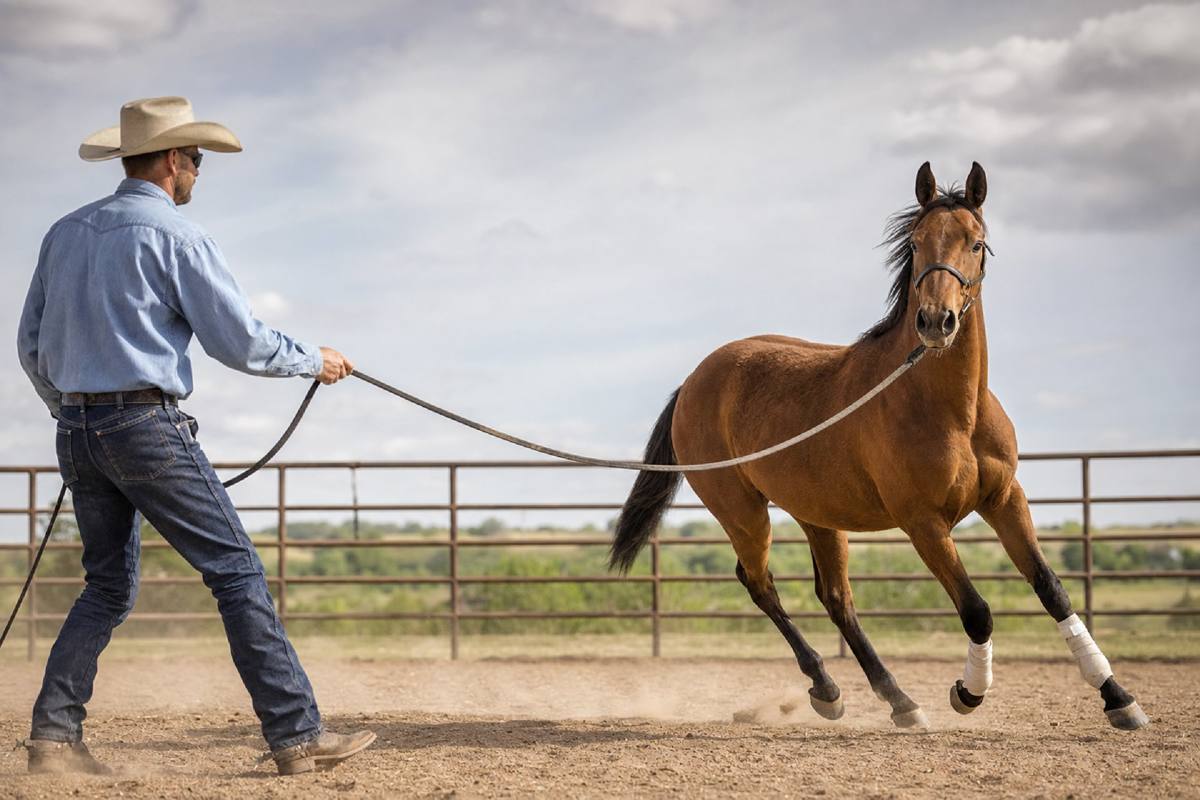
In this lesson, I worked through one of the most important foundation problems I see in young or lightly started horses: they may know how to go around on a lunge line, but they do not yet know how to carry themselves straight, soft, and respectful. That matters long before we ever climb in the saddle. When a horse pushes into me, tips his shoulders, carries his head high, or leans on the circle, he is showing me the same holes that will show up later under saddle.
For the full walkthrough and on-horse examples, watch the episode here: https://www.youtube.com/watch?v=kZ0gqqYg_xs. I also recommend jumping to the key moments I reference below if you want to study a specific piece of the conversation in more detail.


What you need first
Before this work makes sense, I want a horse that already understands the basics of lunging: he should know how to travel on a line, respond to my voice, and accept the presence of the handler around him. If your horse is brand new to the circle, start with plain lunging foundation first. Once that is established, these exercises become much more useful.
If you are already there, this lesson is about cleaning up the details that separate a horse that is merely moving from a horse that is truly carrying himself.
Spotting the real problem on the lunge
I start by watching how the horse handles my space. A pushy horse often argues for position before he ever settles into the job. He may drift into me, swing his hip out, stay tight in his neck, or try to turn the interaction into a wrestling match. That tells me I do not yet have real control of the shoulders.
One of the first things I look for is whether I can influence the front end without the horse simply spinning his hind end away. If I can only move the head and neck, but not the shoulders, then I am not actually steering the body. That is a problem now, and it becomes a bigger problem when I add my weight.
For a closer look at how I assess that shoulder control, see this segment: https://www.youtube.com/watch?v=kZ0gqqYg_xs&t=238s
Teaching the shoulders to move away
My first real button is simple: I want the horse to step his shoulders away from my pressure. I use my hand, my body position, and the line to ask the front end to unlock. I am not looking for a quick escape through the hip; I want the shoulder to come up and away so the horse stays organized on the circle.
That is why I keep testing the same response. If he tries to cut in, twist his body, or claim the inside of my space, I go right back to the shoulder. I want him to understand that the circle belongs to me, and his job is to stay out on it with his body aligned.
This is also the point where I pay very close attention to his body language. I am watching his ears, his neck, his eyes, and the way he feels in my hand. Horses tell the truth with tension, and I want to answer the question they are asking before it turns into a bigger fight.
Pressure, release, and forward response
Another major piece of this lesson is teaching the horse to come forward off pressure instead of bracing against it. If I only bump, yank, or fight the line, I create a horse that hides from contact. That is not what I want. I want a horse that learns to step into the ask and soften when he feels me maintain the feel.
When I ask for a downward transition or a change in pace, I keep the pressure consistent until I feel the horse release. Then I give back. That timing is what makes the lesson clear. If I let go too early, I lose the message. If I stay heavy after he answers, I make him defensive.
I also like to move my feet instead of standing still and trying to win a tug-of-war. By stepping to the side and using my whole body, I can pull the horse off balance just enough to invite him forward instead of allowing him to lean back and brace. That is a small detail, but it makes a huge difference.
For more on this part of the lesson, watch here: https://www.youtube.com/watch?v=kZ0gqqYg_xs&t=445s
Using the lunge line to prepare for riding
Everything I do here is about setting up the horse for the day I swing a leg over him. If he can come forward softly off the line, hold his body up, and stay with me mentally, then I am building a horse that is safer to ride, safer to handle, and easier to develop.
I am not just teaching motion. I am teaching balance, softness, and responsibility. That includes the horse’s ability to:
- step forward without leaning
- stay out on the circle without crowding me
- carry his head and neck in a more useful frame
- accept transitions without arguing
- begin to organize his body for saddle work
This is exactly why I spend time on the line before I ever ask for real work under saddle. If I ignore these problems now, I will be riding into them later.
Balanced loping before the saddle goes on
Once I ask the horse to lope, I am still looking for the same thing: balance. A horse that dives inward, falls on the forehand, or tips his body through the circle is telling me he is not ready to carry weight well yet. That is not a saddle problem; it is a foundation problem.
When I step toward the horse in the lope, I am asking him to stand back up through his outside shoulder and organize the rest of his body around that. The goal is not speed. The goal is not to make the circle bigger or smaller just for the sake of it. The goal is to help him find a better way to travel so the inside hind can step under instead of the whole body falling apart.
If you watch the full segment, you will see how much work can be done before a horse ever gets his first real ride. That is the point of this stage: we are fixing the holes before they become habits. See that part here for the full example: https://www.youtube.com/watch?v=kZ0gqqYg_xs&t=651s
Practical takeaways
Here is what I want you to remember from this lesson:
- A horse that pushes on the lunge is not just disrespectful; he is often showing you a balance issue.
- If I can only move the head, I do not yet have the shoulders.
- Pressure has to be clear, consistent, and followed by a release the moment the horse answers.
- Moving my feet and using my body helps me influence the horse more effectively than just pulling harder.
- Good lunging is not busywork. It is the beginning of safe, useful riding.
What to practice next
If you are working on this with your own horse, I suggest focusing on three things:
- Get a clean response to shoulder control on the circle.
- Practice forward and downward transitions with steady pressure and a timely release.
- Watch your horse’s balance at the lope and help him stay upright before you ever add more saddle work.
Once those pieces start to improve, you will usually feel it everywhere else: in your handling, in your rides, and in the horse’s willingness to stay with you instead of against you.
For the full demonstration and to see the timing in real time, watch the episode here: https://www.youtube.com/watch?v=kZ0gqqYg_xs. If you want to revisit the key moments, use the deep links above to jump straight to the shoulder work, the pressure-and-release lesson, and the balanced loping section.
Support this writer
If this article helped you, leave a one-time tip.


