
Watch the full episode here for the on-horse examples and timing that go with this lesson.
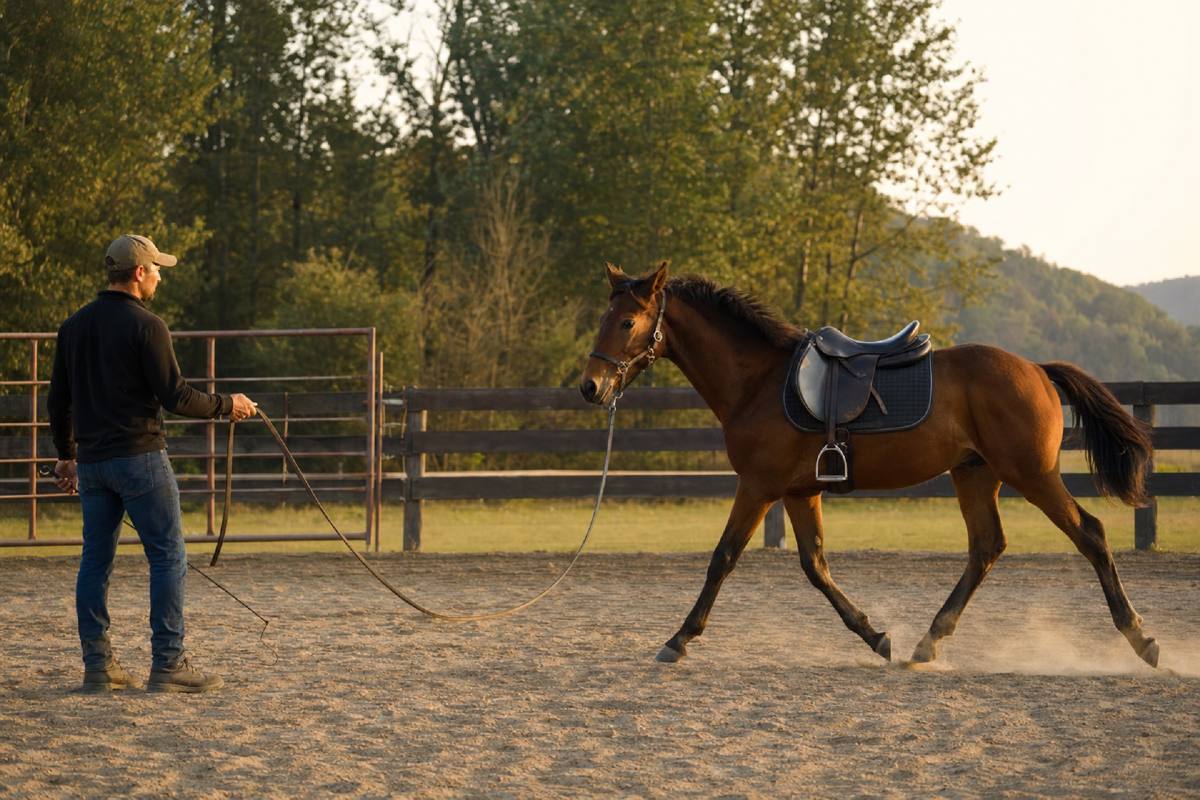
When I longe a colt, I am not just sending him in a circle to burn energy. I am using that circle to teach him how to carry himself, listen to my cues, and stay mentally with me. In this session, I’m building on the previous groundwork and pushing the horse toward better transitions, better balance, and better responsiveness before we get under saddle.


What you need first
Before I use lunging this way, I want the horse to already understand the basics of:
- leading and handling on the ground
- moving forward without panic
- accepting basic pressure from my voice, line, and whip
- the first saddling stage, or at least being ready for saddle introduction
This is foundation work, but it is not random exercise. If I’m going to make lunging useful, the horse has to understand that my aids mean something and that moving his feet correctly is part of the lesson.
Lunge with purpose, not just motion
One of the biggest mistakes I see is people chasing a horse around the circle and calling it lunging. If I’m running after the horse, I am usually losing control of the shape, the rhythm, and the transitions. I want a horse that stays on a consistent circle while I stay balanced and effective in the middle.
I use my own body position to help organize him. I step and turn in a way that lets me influence the shoulder, rib cage, and hindquarters without overdriving him. That gives me a much better chance of improving his shape instead of just making him faster.
As I work, I’m looking for signs that the horse is starting to soften mentally. A lower neck, less frantic feet, and more attention to me tell me I’m making progress. That mental change matters just as much as the physical one.
For the full walkthrough, watch the segment around 03:57.
Fix the body shape, and the lead often fixes itself
When a horse picks up the wrong lead behind or falls out through a shoulder, I don’t assume he is being naughty. I look at the shape of his body first. If the hip is drifting out and the rib cage is not staying lifted, the horse is far more likely to strike off incorrectly.
That is why I want to stand him up into the outside and keep his rib cage organized. If I can bring his body into better alignment, I can often improve the lead instead of constantly restarting him.
My rule here is simple: forward creates correctness. If I drive him forward correctly, I can use that forward energy to help him reorganize his body. That is why I send with purpose rather than just chasing. I am asking him to carry himself better, not just move faster.
Use the whip as a precise backup
The whip is not something I wave around to make noise. It is a backup aid, and it needs to mean something. I start with my voice first. If I need the whip, I want it to back up what I already asked for.
I also want my horse to respect the whip without becoming afraid of it. That means I use it deliberately and aim for a specific response. I am not cracking it idly in the air and hoping he guesses right. I am targeting the rib cage or belly area so the cue connects with movement.
That point of contact matters. If my whip is just noise, the horse will get numb to it. If my whip is accurate, my transitions get sharper and my horse learns that my cues have real meaning.
If you want to see how I set up the whip and target it more precisely, check the section around 10:49.
Introducing the saddle changes the conversation
Once I have a horse beginning to understand the circle, the shoulders, and the transitions, I can start introducing the saddle more seriously. At this point, I am not lunging just to lunge anymore. I am using the saddle as part of the preparation for riding.
The reason I bring the saddle into the work is that some horses will not finish their body shape on the ground alone. If I keep doing the same thing forever, I may actually make the problem worse. But if I begin to layer in the saddle and keep improving the horse’s response, I can start preparing him for the first rides in a way that makes sense.
That also means I am watching for comfort and attitude. I want to feel whether the horse is soft in his body, willing in his mind, and able to stay engaged while I change what I’m asking. If I can touch him, move him, and change directions without losing him, I know I’m making progress.
For more on how I introduce that saddle work in this series, watch the opening segment around 00:09.
Keep the shoulders, then control the body
As the horse improves, I can ask for more precision. I want to keep the shoulders organized first, because once the shoulders are lost, the whole body tends to fall apart. If the horse learns to stay up and out through the outside shoulder, I can better influence the ribs and hip with my whip and line.
This is where a lot of people get frustrated. They bump the face and wonder why the hip keeps swinging out. I don’t want to chase the head without controlling the front end of the body. If I can keep the shoulders where I want them, I have a much better chance of changing the rest of the body behind them.
I also like to test his focus by changing my handling pattern and seeing whether he stays with me. If he can stay attentive when I shift directions or adjust my position, that tells me he is starting to understand that my space matters.
Make the upward transition mean something
When I ask for more energy, I want the response to be immediate. A kiss should not be casual. It should be backed up by a clear, well-timed whip cue if the horse does not step up on his own.
I aim to hit the belly or lower rib area with enough precision that the horse learns to connect my voice, my body, and my whip into one clear instruction. That is what sharpens upward transitions. When I say “go,” I want the horse to step up without delay.
This matters for safety as much as it does for training. A colt that ignores the cue under saddle can get dull, heavy, or unsafe. A colt that learns on the ground that my requests matter is much easier to ride later.
Practical takeaways
- Don’t just circle the horse; use the circle to improve his body shape.
- Keep your own body balanced so you can influence the shoulders and hips.
- Look for the reason behind a wrong lead instead of just restarting.
- Back up your voice with a precise whip cue, not random noise.
- Use lunging as preparation for saddle work and future riding, not as an endless drill.
- Aim for sharper transitions by making every cue clear and meaningful.
What to practice next
If you’re working a young horse, I suggest focusing on three things next:
- Clean up the circle so the horse stays organized through his shoulder and rib cage.
- Practice backing up your voice with a precise, accurate whip cue.
- Use that foundation to prepare for first saddling and the first ridden transitions.
For the full demonstrations and timing, watch the episode here, and revisit the linked segments as you work through each piece of the lesson.
Support this writer
If this article helped you, leave a one-time tip.


