
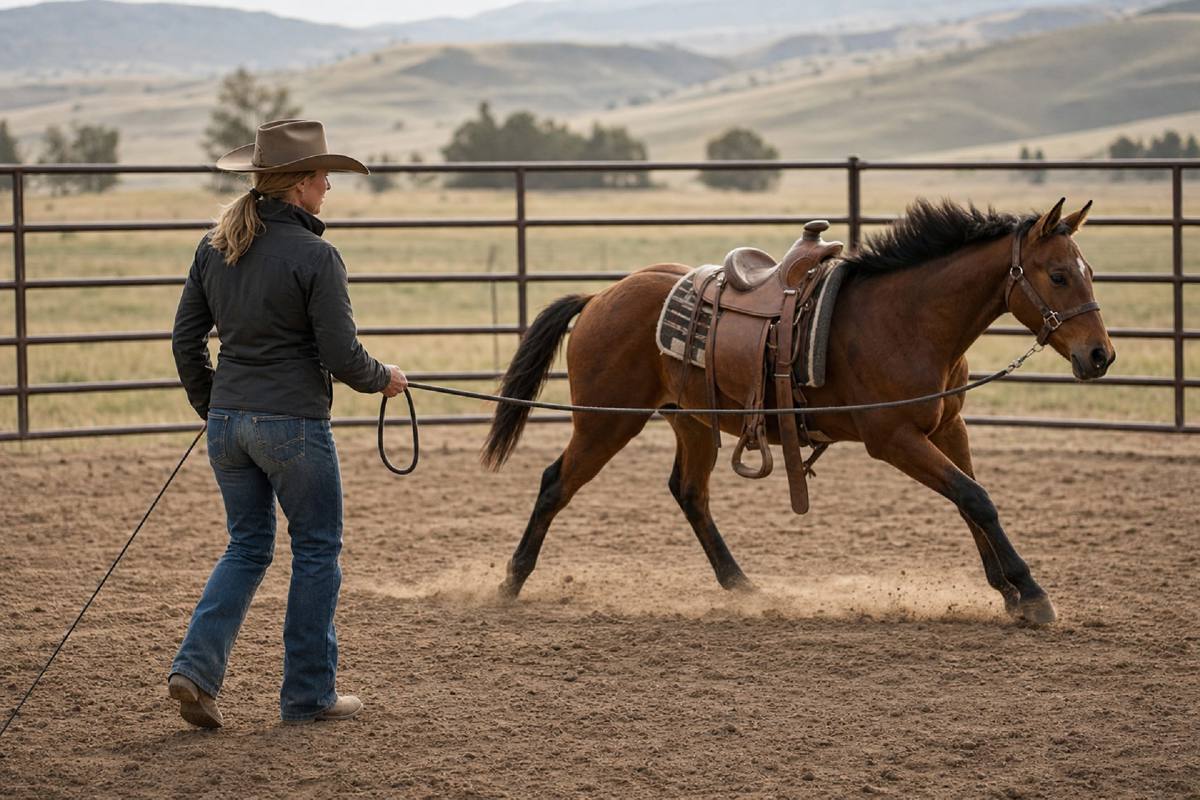
Jeremy LaRose of ProHorseTrainer uses this colt-starting episode to make one central point: the early rides are not about tiring a young horse out, they are about organizing his mind. In the first sessions, Jeremy wants the colt to understand forward movement, stay on the circle, and accept the rider’s direction without adding extra drama. That foundation makes the first rides safer, more predictable, and easier to build on.
Watch the source video here: Colt Starting 101 and jump to the lesson start with this deep link.


What you need first
Before you use this lesson under saddle, Jeremy’s approach assumes a few basics are already in place:
- Mounting comfort: the horse can accept being saddled and handled without escalating.
- Lunging foundation: the colt understands the circle, forward motion, and basic directional changes on the ground.
- Forward-motion groundwork: the horse can keep working when asked instead of stopping, spinning, or drifting off task.
Because this episode includes both groundwork ideas and under-saddle preparation, the key takeaway is to treat the groundwork as preparation for riding rather than proof that the horse is already finished.
Forward motion is the first safety skill
Jeremy starts by emphasizing that the colt’s job is to keep going forward. At this stage, he is not asking for perfection; he is asking for commitment.
A young horse that keeps moving in a predictable circle is easier to manage than one that stops, reverses, spins, or launches into sudden changes. Even if the horse is fresh, Jeremy is more concerned with direction and consistency than with perfect calm. In his view, forward motion gives the rider something to work with, while unpredictable reactions create the real danger.
This is why he prefers to see the colt maintain the pattern and the gear he has been given. If the horse stays organized, the rider can stay balanced and make the next request with more confidence.
Why this matters for the first rides
On a first ride, the rider is already managing a lot. If the horse also decides to stop, whirl, or change direction on its own, the rider loses predictability. Jeremy frames that predictability as one of the biggest safety tools in colt starting.
Stay in front of the horse mentally
A major theme in the episode is timing and position. Jeremy explains that riders get into trouble when they are reacting to the horse instead of directing the horse. He wants the trainer to think ahead, stay one step or several steps in front, and keep the horse answering rather than leading the conversation.
That means the teacher sets the tone. The horse should be the one responding to the rider’s cues, not the rider scrambling to catch up with whatever the horse invents next.
Build the habit of leading the conversation
Jeremy describes this as a teacher-student relationship. The point is not to argue with the colt, but to stay clear and deliberate enough that the horse understands what comes next. When the rider is mentally ahead, the horse has less room to take control of the exchange.
Clean transitions teach the horse to answer, not argue
Once the colt is moving forward, Jeremy uses transitions to keep him focused and to expose holes in his understanding. The goal is not just to move through gaits, but to do so without extra behavior such as head tossing, bracing, kicking out, or trying to derail the request.
If the colt adds resistance, Jeremy does not treat that as the end of the lesson. He sees it as information. The answer is to re-present the task, refine the cue, and keep the horse working through the same conversation until the horse gives the simple, correct response.
Extra motion is not the point
Jeremy is careful not to reward the wrong thing. If the horse bucks, throws his head, or gets tense during a transition, that behavior does not become a reason to quit. Instead, the horse is sent back to work so the lesson stays clear: the transition happens, and the job continues.
How this shapes the first ride
This approach helps the colt learn that transitions are ordinary, not dramatic. Over time, that creates a horse that is easier to ride because the rider can expect the next step instead of bracing for a surprise.
Do the opposite of your horse’s mentality
Another key idea in the episode is emotional matching. Jeremy says a good trainer does not mirror the horse’s mood; the trainer balances it.
- If the horse is tense or highly alert, the rider should stay calm, slow, and steady.
- If the horse is too quiet or dull, the rider may need to bring more energy and presence.
That does not mean becoming emotional. It means being intentional. Jeremy’s point is that horses learn best when the handler fills the gap in the horse’s attitude rather than amplifying it.
Calm is contagious
For a hot, edgy young colt, a quiet and controlled rider helps lower the overall energy. For a laid-back horse, a trainer may need to create more spark to keep the horse engaged. In both cases, the trainer adjusts to the horse instead of expecting the horse to match the trainer.
Mistakes are training opportunities
Jeremy also makes a useful long-term point: mistakes are not failures in colt starting. They are chances to learn, adjust, and reward the right answer once the horse gets there.
A horse that asks questions can be taught more clearly because the trainer can identify where the hole is. That is why Jeremy values a horse that shows a little resistance or personality; it gives him something real to improve.
The bigger risk, in his view, is not the horse that makes mistakes. It is the horse that never reveals confusion, because then the trainer has fewer chances to refine the communication.
Set the tone early
Jeremy closes the lesson with the reminder that the first 30 days matter a lot. The tone you establish at the beginning can shape how the horse feels about work for a long time.
If the early experience is rushed, harsh, or chaotic, the horse may carry that stress forward. If the first lessons are thoughtful, calm, and clear, the horse is more likely to trust the process and stay a willing student.
That is the real lesson of this episode: the best colt-starting program builds confidence by making forward motion, transitions, and emotional balance feel normal from the beginning.
Practical takeaways
- Focus on forward motion before chasing perfection.
- Keep the horse on a predictable line so the next step is easier to ride.
- Use transitions to test attention and refine the cue.
- Stay calm when the horse gets reactive; do not match the drama.
- Treat mistakes as information, not as the end of the session.
- In early colt starting, consistency matters more than intensity.
What to practice next
- Review your lunging fundamentals and confirm the horse can stay on a circle with purpose.
- Practice asking for forward motion without letting the horse drift, stop, or turn in.
- Introduce transitions that reward a simple answer and immediately correct extra behavior.
- Work on your own timing and emotional control so you can stay ahead of the horse mentally.
- Build short, clear first-ride sessions that end with the horse still organized and thinking forward.
Jeremy LaRose’s approach in this episode is a strong reminder that a good start is built on clarity, not force. If you can keep the horse forward, focused, and mentally with you, the first rides become much easier to develop into dependable work.
Support this writer
If this article helped you, leave a one-time tip.


